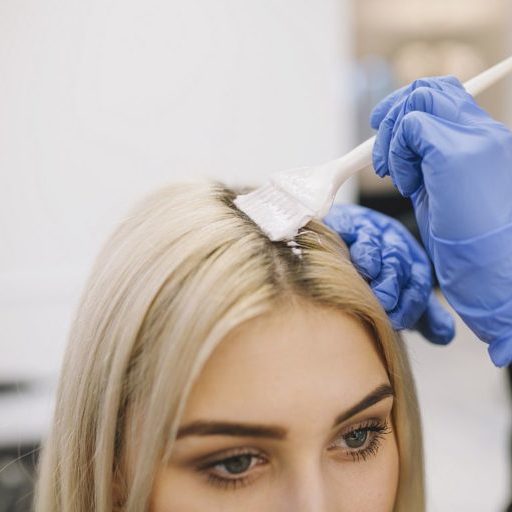
Hair coloring, or hair dyeing, is the practice of changing the hair color. The main reasons for this are cosmetic: to cover gray or white hair, to change to a color regarded as more fashionable or desirable, or to restore the original hair color after it has been discolored by hairdressing processes or sun bleaching.
Hair coloring can be done professionally by a hairdresser or independently at home. Today, hair coloring is very popular, with 75% of women[1] and 18% of men living in Copenhagen having reported using hair dye according to a study by the University of Copenhagen. At-home coloring in the United States reached $1.9 billion in 2011 and is expected to rise to $2.2 billion by 2016.
<b>Hair coloring</b>, or <b>hair dyeing</b>, is the practice of changing the <a class="mw-redirect" title="Hair color" href="https://en.wikipedia.org/wiki/Hair_color">hair color</a>. The main reasons for this are <a title="Beauty" href="https://en.wikipedia.org/wiki/Beauty">cosmetic</a>: to cover <a title="Human hair color" href="https://en.wikipedia.org/wiki/Human_hair_color#Gray_and_white_hair">gray or white hair</a>, to change to a color regarded as more fashionable or desirable, or to restore the original hair color after it has been discolored by hairdressing processes or sun bleaching.
Hair coloring can be done professionally by a hairdresser or independently at home. Today, hair coloring is very popular, with 75% of women<sup id="cite_ref-1" class="reference"><a href="https://en.wikipedia.org/wiki/Hair_coloring#cite_note-1">[1]</a></sup> and 18% of men living in <a title="Copenhagen" href="https://en.wikipedia.org/wiki/Copenhagen">Copenhagen</a> having reported using hair dye according to a study by the <a title="University of Copenhagen" href="https://en.wikipedia.org/wiki/University_of_Copenhagen">University of Copenhagen</a>. At-home coloring in the United States reached $1.9 billion in 2011 and is expected to rise to $2.2 billion by 2016.